In hospitality, the most important shifts rarely arrive with drama.
They arrive quietly. Through small changes in how guests search, how long they stay, what they value, and what they no longer tolerate. By the time the shift is obvious, the advantage has already moved.
That is what made 2025 such a consequential year.
On paper, it looked stable. Global travel continued its recovery. Occupancies held. New properties opened. But behind those reassuring indicators, the industry began operating by a different logic. One shaped less by volume and more by intent.
For hoteliers paying attention, 2025 was not about growth. It was about relearning how demand actually behaves.
What 2025 Revealed, If You Looked Closely
1. Guests Did Not Disappear. They Became More Selective.
Global travel demand remained strong in 2025, supported by rising international arrivals and steady leisure movement. The UN World Tourism Organization reported that international tourism had recovered to over 90 percent of pre-pandemic levels by late 2024, setting the stage for sustained demand through 2025.
Yet this demand came with sharper discernment. Guests compared more options, delayed decisions, and evaluated value with greater care. They were still willing to spend, but only when the experience felt worth it.
This selectiveness explains why some destinations and properties outperformed their markets while others plateaued. It was not about location alone. It was about relevance.
2. Booking Journeys Became Layered and Nonlinear
One of the most understated changes in 2025 was the shift from inspiration to confirmation for guests.
Research from Skift and Phocuswright indicates that travelers increasingly use multiple platforms before booking, including search engines, metasearch, social content, and brand websites. Very few journeys now follow a straight line from discovery to purchase.
This fragmentation reshaped visibility economics. Being present in one channel was no longer sufficient. Hotels needed to show up consistently, clearly, and credibly across the entire journey.
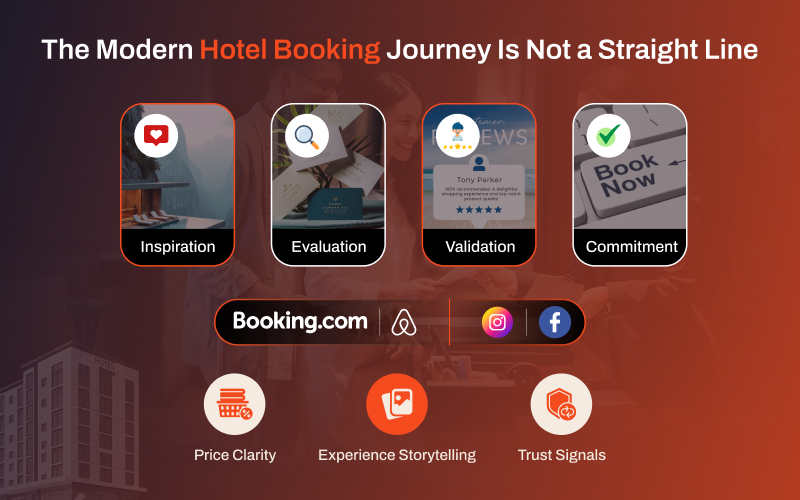
The hotels that benefited most were those that treated discovery, comparison, and conversion as connected moments rather than isolated functions.
3. Shorter Stays Became the Dominant Pattern
Data from STR and Statista indicate that the average length of stay continued to edge downward across many regions in 2025, particularly in urban and resort markets driven by leisure demand.
Guests traveled more often, but for fewer nights. This was not a temporary correction. It reflected a broader shift in how people allocate time and money.
For hotels, this changed the math. Turnover increased. Margins tightened. And the pressure to extract more value per night intensified.
Those who adapted focused less on extending stays and more on enriching them.
4. The Definition of Revenue Quietly Expanded
As room rate growth moderated, attention turned to the full economic footprint of each guest.
Industry analysis from Deloitte highlights that hotels focusing on total spend per guest, including dining, wellness, experiences, and partnerships, showed stronger resilience than those relying primarily on room revenue.
This was not about adding more options. It was about offering the right ones, framed in ways that felt intentional rather than transactional.
2025 reinforced a long-standing truth. Profitability is shaped as much by experience design as by pricing.
5. Technology Became Invisible, Which Is Exactly the Point
By 2025, digital convenience stopped being a differentiator and started being an expectation.
Mobile check-in, messaging, automation, and data-driven recommendations were no longer noticed when they worked well. They were only noticed when they failed.
According to McKinsey, travel and hospitality companies that integrated data across systems improved decision speed and customer satisfaction significantly compared to those operating in a patchwork of platforms.
The lesson was not about tools. It was about the perfect orchestration between systems.
Why 2026 Will Be Less Forgiving
If 2025 was about adjustment, 2026 will be about consequence.
The margin for imprecision is narrowing.
1. Personalization Will Shift From Reactive to Predictive
Guests already expect hotels to remember preferences. What comes next is anticipation.
Research by BCG shows that companies using predictive analytics to tailor experiences can drive revenue uplift of 10 to 20 percent. In hospitality, this means knowing what a guest is likely to need before they ask.
This is not about excess communication. It is about relevance delivered quietly and correctly.
2. Wellness Will Shape Brand Choice, Not Just Amenities
Wellness travel continues to grow faster than general tourism, with the Global Wellness Institute estimating the sector to exceed one trillion dollars globally by the end of the decade.
For hotels, wellness is no longer confined to spas. It influences room design, food philosophy, sleep quality, and overall pace of the stay.
In 2026, wellness will increasingly determine where guests choose to return.
3. Luxury Will Become More Emotional Than Material
Luxury travel remains resilient, even in uncertain economic climates. According to Knight Frank, the population of ultra-high net worth individuals continues to grow, supporting sustained demand for high-end hospitality.
But the definition of luxury is evolving. Space, privacy, storytelling, and emotional resonance now outweigh overt opulence.
Hotels that understand this shift will outperform those that equate luxury solely with scale or price.
4. Sustainability Will Move From Values to Verification
Environmental responsibility is no longer judged by intent. It is judged by evidence.
WTTC research shows that travelers increasingly factor sustainability practices into booking decisions, particularly in Europe and Asia-Pacific.
In 2026, hotels that can clearly explain and quantify their impact will earn trust. Those who cannot will face a quiet erosion of their preferences.
5. Insight Will Matter More Than Instinct
The era of retrospective reporting is coming to an end.
Hotels are shifting toward real-time analytics that inform pricing, distribution, and experience decisions continuously. According to Gartner, organizations using real-time data outperform peers across profitability and customer satisfaction metrics.
In 2026, competitive advantage will belong to those who see change as it happens, not after it passes.
6. Guest Experience Becomes the Ultimate Differentiator
By 2026, the most important metric will not just be occupancy or revenue per available room. It will be how guests feel at every touchpoint of their stay.
Hotels that deliver seamless, memorable, and emotionally resonant experiences will outperform those that focus only on operational efficiency. This includes everything from anticipating guest needs before arrival to curating local experiences to ensuring every interaction, whether digital or in-person, feels intuitive and thoughtful.
According to a recent Deloitte report, properties that focus on experience-driven differentiation see significantly higher loyalty, repeat bookings, and positive online reviews.
Experience is no longer optional. It is the business. Hotels that embed it in every operational and digital decision will define leadership in 2026.
How Yanolja Cloud Solution Fits Into This Shift
Many of the shifts shaping hospitality today share a common thread. They demand connection. Between systems. Between data points. Between moments in the guest journey that were once treated separately. This is where the role of hospitality technology is changing.
Platforms such as Yanolja Cloud Solution are not positioned as single-purpose tools, but as connective layers that help hotels operate with coherence rather than complexity. By bringing together core systems like property management, distribution, revenue intelligence, and guest engagement into a unified environment, hotels gain something increasingly rare in this industry: Clarity.
Clarity about who the guest is across touchpoints.
Clarity about demand signals as they form, not after they pass.
Clarity about how decisions in one part of the operation affect outcomes elsewhere.
In a landscape where personalization is becoming predictive, booking journeys are increasingly fragmented, and insight must arrive in real time, this kind of connected foundation matters. Not because it is visible to the guest, but because it allows the experience to feel seamless, relevant, and intentional.
As hospitality moves deeper into this next phase, platforms like Yanolja Cloud Solution support hotels not by dictating strategy, but by enabling better ones. Quietly. Reliably. At scale.

Final Thoughts
Hospitality is entering a more demanding era, not a louder one.
The signals from 2025 were clear for those willing to notice them. Guests are not chasing more. They are chasing better. Better use of time. Better alignment with values. Better experiences that feel considered rather than constructed.
2026 will not reward excess or complexity. It will reward clarity. Hotels that understand who they are, what they stand for, and how their guests want to feel will pull ahead. Not through grand reinvention, but through thousands of precise decisions made with intent.
The future of hospitality will belong to those who treat insight as a discipline, not an instinct. Who see technology as an enabler, not a distraction. Who designs experiences with meaning, not noise.
This is not a moment of reinvention. It is a moment of definition.
And the hotels that define themselves well now will shape how the next chapter of travel is remembered.